Chao Sheng (盛超)


Selected Projects

WORKSTATION
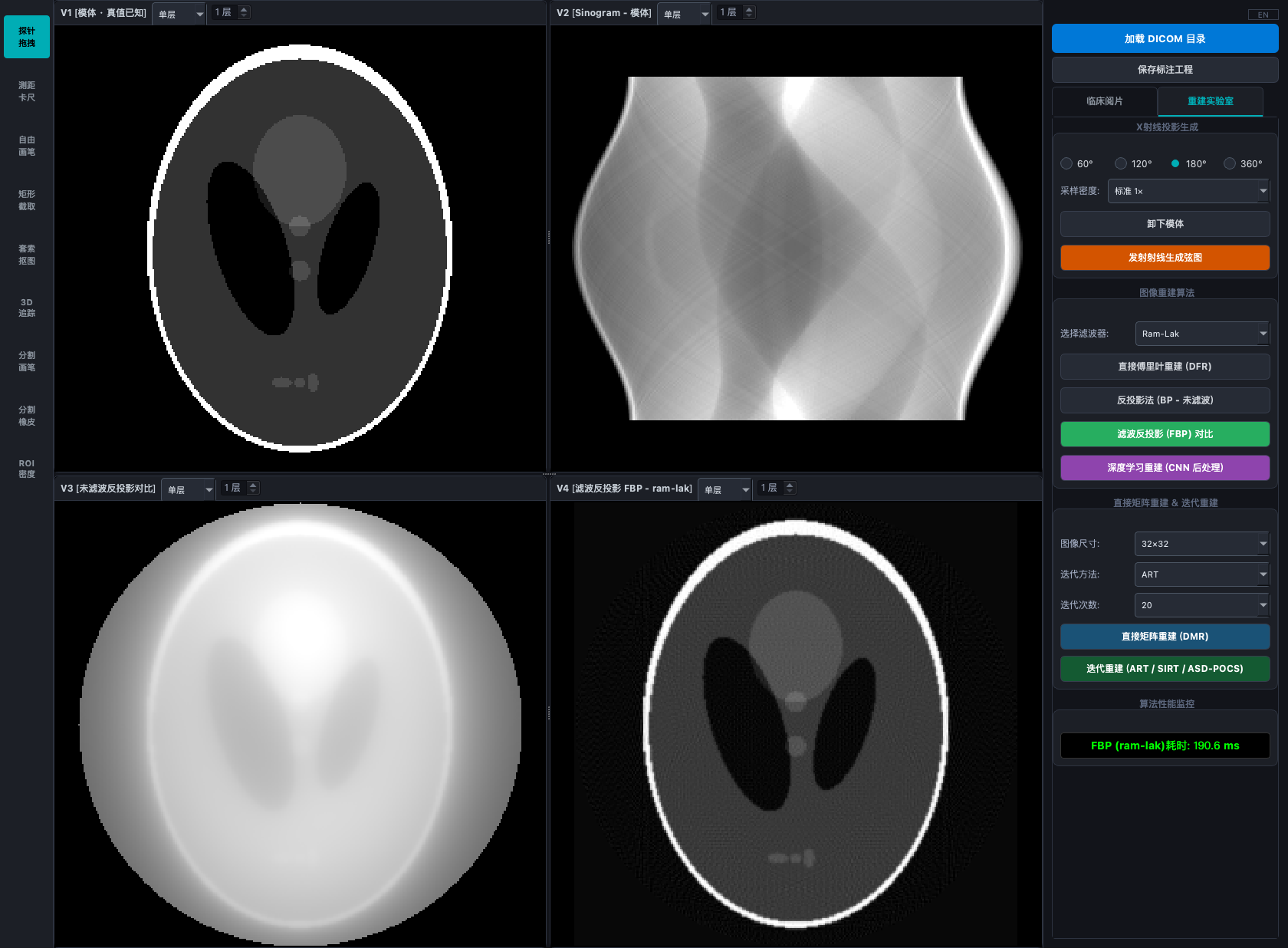
CT reconstruction interface with a synthetic Shepp–Logan phantom

Actual interface · Open full image

3D Segmentation & Reconstruction Workstation

PySide6 · NumPy · ONNX Runtime · CT Reconstruction

A desktop workbench integrating 3D image processing and reconstruction. Implemented DICOM loading, MPR, segmentation and ROI measurements, added spatial-geometry checks and project save/restore, and corrected missing spacing resampling in segmentation preprocessing.

Implementation & validation

An interactive workbench for 3D processing and reconstruction experiments. Supports DICOM loading, three-plane MPR, multi-organ segmentation, ROI measurements and project save/restore. Checks series identity and spatial geometry to prevent misplaced masks and stale cache reuse.

Implemented direct Fourier and several iterative CT reconstruction methods, with residual U-Net experiments for sparse-view reconstruction. Correcting missing spacing resampling improved mean Dice from 0.684 to 0.840 in a historical paired comparison of 20 cases from the same public data source.
The Dice comparison and the reconstruction screenshot are separate experiments. These results are not independent clinical validation. The software is for education and research.

RARE26: Cross-domain Classification & Ensemble Inference

PyTorch · ResNet-50 · GastroNet · Docker

Cross-center classification experiments with packaged ensemble inference. Used near-duplicate grouping and bidirectional leave-one-center-out evaluation, aligned training and inference preprocessing, and built a Docker container with time-budget scheduling and timeout fallback.

Implementation & validation

A competition project for endoscopic classification with few positive samples. The task objective is precision at 90% recall. Uses GastroNet-pretrained ResNet-50, class sampling, EMA, near-duplicate grouping and bidirectional leave-one-center-out evaluation.

Aligned training and inference preprocessing, averaged probabilities from 12 random-seed models and applied horizontal-flip augmentation. Packaged inference in Docker with time-budget scheduling, timeout fallback and input/output checks.

Internal LOCO evaluation supported method selection; it is not an independent test result for the final submitted weights. No competition ranking is claimed.

CAMERA ABLATION
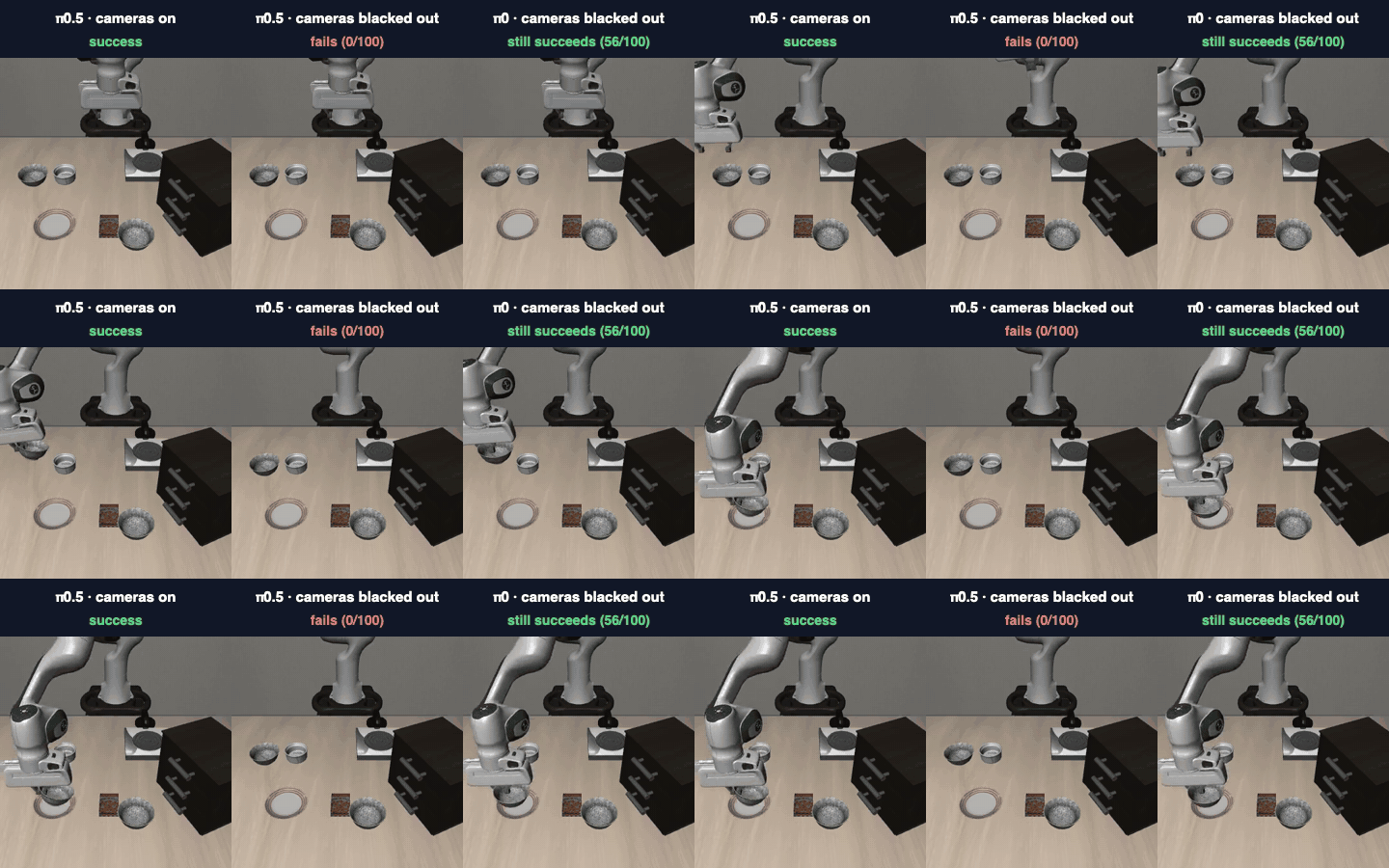
Three runs of the same LIBERO task: pi0.5 with normal cameras succeeds, pi0.5 with blacked-out cameras fails, pi0 with blacked-out cameras still succeeds

Simulator recording · Open results dashboard

Camera-input Ablation of Vision-Language-Action Policies

LeRobot · OpenVLA · MuJoCo · LIBERO · Embodied AI

Testing whether robot policies actually use their cameras. Reproduced five public policy checkpoints, with 95% intervals overlapping the published benchmarks, then blacked out, froze, noised or removed camera inputs for π0, π0.5, OpenVLA and SmolVLA on LIBERO-Spatial.

Implementation & validation

With all cameras blacked out, three of the four policies fail completely. π0.5, OpenVLA and SmolVLA dropped to 0%; the public LeRobot π0 checkpoint still succeeded in 53–56% of episodes across five runs, against 71–76% with normal input. Freezing the first frame also took π0.5 and SmolVLA to 0%.

Compared end-effector paths with dynamic time warping to bound what the π0 result means. All runs used one RTX A5000 workstation with headless EGL rendering and wrapper scripts, without modifying upstream code. CI recomputes the published tables from the raw evaluation files.

One benchmark suite and one seed, 100 episodes per ablation run; differences below about 13 points are not meaningful. The public π0 checkpoint is undertrained, so its result does not describe π0 in general. All reported results use public checkpoints.

MedAudit: Image Classifier Reliability

NumPy · Python CLI · Data Leakage · Calibration

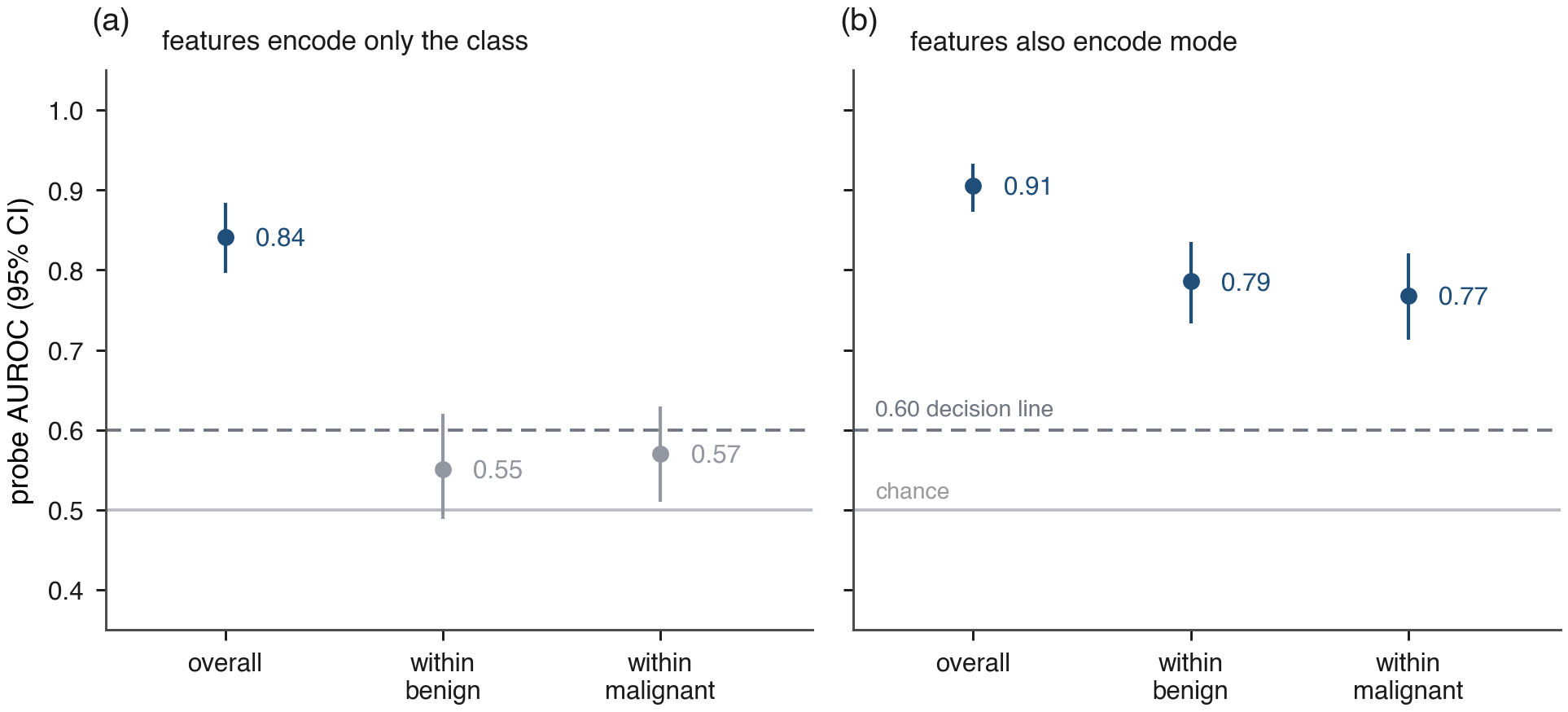
A command-line tool for leakage, near-duplicate and feature-attribute checks. Implemented overall and within-class attribute probes, with an accompanying English tutorial and synthetic examples explaining evaluation results and their limits.

Companion work: MICCAI Educational Challenge 2026 Finalist

Implementation & validation

A runnable audit workflow for leakage, near-duplicates and feature attributes. The configuration-driven CLI supports cross-split near-duplicate checks, patient-group leakage checks and overall/within-class attribute probes. Metric functions include AUROC, Brier score, ECE and patient-cluster bootstrap.

Includes an English tutorial, running guide and runnable synthetic examples. The companion work From Pixels to Patients was a finalist in the MICCAI Educational Challenge 2026.

Predictable attributes do not establish that the classifier relies on them. Synthetic examples are not clinical performance evidence. The full calibration audit is not yet integrated into the CLI.

Synthetic experiment comparing overall and within-class attribute probes
Synthetic comparison; open full image. Not clinical performance evidence.

HCC-MVI: Multi-phase CT Feature Extraction

SimpleITK · PyRadiomics · scikit-learn

Reconstruction of a multi-phase CT feature extraction workflow with output verification. Connected tumor/peritumoral regions, radiomic features and model fusion, ran deduplication sensitivity and confidence-interval analyses, and retained failure records for traceability.

Implementation & validation

Reconstructing the data-processing chain for multi-phase images, features and model fusion. Used 111 historical cohort records to reconstruct workflows for four-phase CT, 3D tumor/peritumoral volumes of interest and 94 original radiomic features, with deduplication sensitivity and confidence-interval analyses.

Completed recomputation checks for 6,660 volumes of interest, covering valid-feature consistency and reproduction of failure records in a traceable workflow.

The count includes failure records and does not mean every volume yielded valid features. Current evidence does not establish model validity. Patient data and internal materials are not public.